Baselworld Approaches

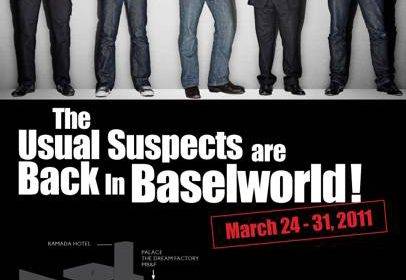
Tomorrow I leave for Basel.  This is MB&F’s third year in a row exhibiting there and the second in The Dream Factory.  The Dream Factory comprises MB&F, URWERK, Speake-Marin, and Christophe Claret – certainly one of the most exciting areas of the fair!


The Dream Factory is in The Palace Hall.  If you will be in Basel, please do stop by.  We are open to the public and will have some of our collecting in showcases to view.  However, if you would like to get a more personal look at the collection, I have a few appointment spots in my schedule left.  Contact me through the link at the top of the blog and we’ll book a meeting.

See you there!

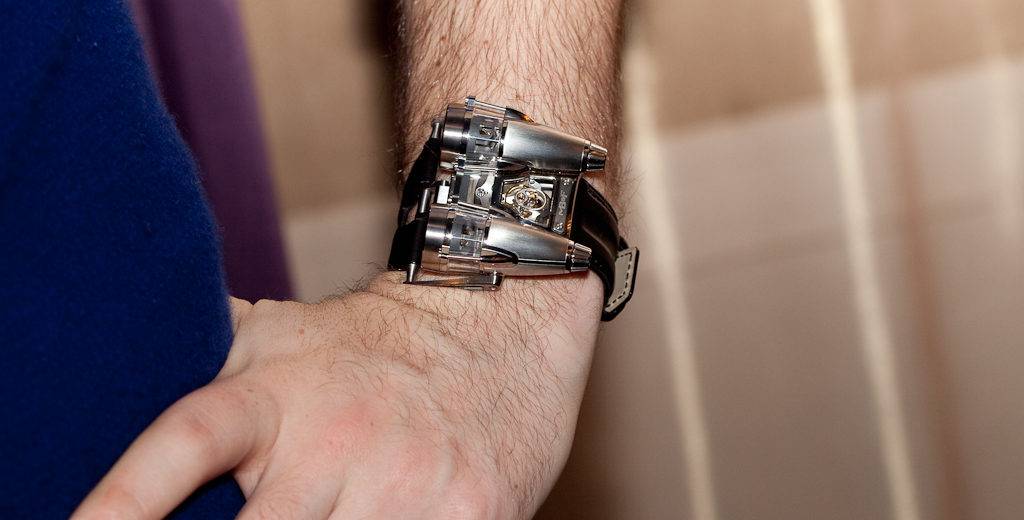
Collecting History: MB&F Horological Machine #4 (HM4)

I started and run MB&F North America.  That means I am responsible for basically anything you see here in the US – from a watch in a showcase to an article in a magazine.  So when I say that the MB&F HM4 is my favorite watch that I have owned, I don’t blame you for thinking I am biased.

However, those who know me know that I am, indeed, biased.  I truly believe MB&F are making the most interesting and best watches in the world and that is why I am involved with them in the first place.  I certainly had no need or desire to work in the watch industry otherwise.  I was a watch collector long before I started with MB&F, and it is the knowledge that I gained through my collecting (much of which I have shared in this series) that makes me comfortable representing this company and buying pieces like this with my own money.

Yesterday I talked about how URWERK ushered in a new genre of post-quartz watches.  MB&F, particularly with HM4 has taken that and moved it forward.  The piece expands the limits of possibility.  For me, it brings me back to my childhood.  I would design cars in my head and could not figure out why no real car company would ever make something as cool.  It would use the best possible materials of the time, have 800 horsepower, all the newest technologies, basically be a Formula 1 car with two seats and a beautiful interior.  Why didn’t anyone make that car?  Well I can only assume the practical realities of sales and production got in the way.

HM4 has no compromises.  Whereas other watches could be seen as sculptures, even the movement of this watch has been wholly conceived as a sculpture of its own.

photo credit to Paul Boutros

The case shows no compromises.  An incredibly complex shape to manufacture, the back portion is a milled solid block of titanium taking 50+ hours, and the center sapphire section takes nearly 200 hours to machine!

photo credit to Paul Boutros

There is a reason that few, if any, watches deviate from the norm so much and require so many complex production techniques: it is fantastically difficult to pull off, incredibly expensive, and unimaginably risky.  And that is why this is my favorite watch.

I know the team behind it very well.  They have pushed themselves to the max (pun sort of intended) and put their lives on the line, at least professionally, to create a sculpture that they truly believe in.  That is why I love watchmaking, and, in the end, why these little micro machines which serve no necessary purpose have a true, lasting value.

Looking back on this era, I believe this will be one of the most important pieces.  There is no better example of what a watch can be if you free yourself from the need to copy what has come before.  Watch as art.

photo credit Paul Boutros

I hope you have enjoyed this series.  My goal was to give a look inside the mind of a watch collector, and also to document the history of a golden era in watchmaking which is still unfolding.  While they may seem trivial, these watches have actually changed my life and the way I think.  They have also led me to meet many fantastic people, and for that I am grateful to all of these brands and creators.

Collecting History: URWERK 103

Where Richard Mille helped to subtly usher in a new world of horology, URWERK really founded what I now call Contemporary Horology.  From the advent of the quartz era until the late 1990′s, watchmakers had been focused on the past – slightly changing the same watches over and over again.  The 103 is a true landmark piece.  It represents a watchmaker and designer of an entirely new generation (my generation!) creating a piece of horology from their own point of view.  The sci-fi references, casual style and rethinking of the entire time-telling device is all decidedly post-quartz.  This is the moment where I believe we can start viewing watches as art pieces.

Like most good art, it did not catch on immediately.  Richard Mille had drawn on familiar characteristics of a watch to ease people into the modern world.  URWERK did away with all of that.  I recall an early 103 piece sitting in a lonely showcase seemingly forever.  Now collectors salivate over it.

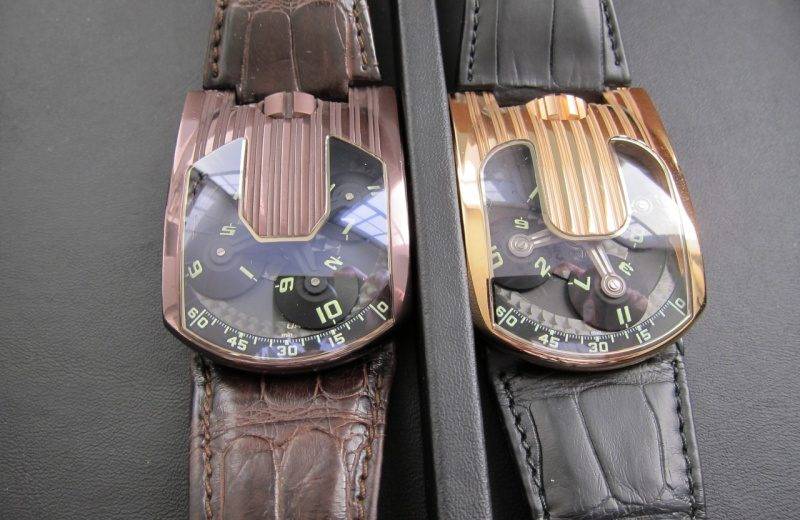
Personally, I must admit that I did not fully “get it” until the 103.03, the first time the case was opened up to reveal more of the mechanism.  I bought one of the first pieces to come into the country – my first “super exotic”.  If Richard Mille is a Ferrari, now we are talking about a Pagani Zonda.  The watch really felt like it was of my generation – I was proud to wear it.

As an aside, my wife, who is much smarter and infinitely more stylish than I am “got it” immediately.  When she had the opportunity to buy herself a really nice watch, she picked a rose gold 103.09, shown below in a his and hers shot.

So when it comes to collecting and historical relevance, I like to look at who is doing something the best.  To me, URWERK and MB&F are best representing Contemporary Horology.  They both recognize that the mechanical watch has been freed of its practical necessities and can, instead, be used as a sculpture.  While I love mostly everything that URWERK does, the 103 series represents an important point in my life and collecting history, and therefore is still my favorite.  No collection of 21st century horology is complete without one.

Tomorrow, for my last Collecting History post, I’ll take a look at the logical conclusion and my favorite watch I have ever owned, the MB&F HM4.

Collecting History: FP Journe Tourbillon Souverain

If there was one overdone trend in the last 10 years, it was the tourbillon.  Modern production techniques made commonplace what was once the ultimate show of a watchmaker’s skill.  Combined with buyers’ willingness to spend more money on watches, as I discussed yesterday, tourbillons provided the perfect opportunity for companies to sell extraordinarily expensive watches that will eventually hold little historical interest.

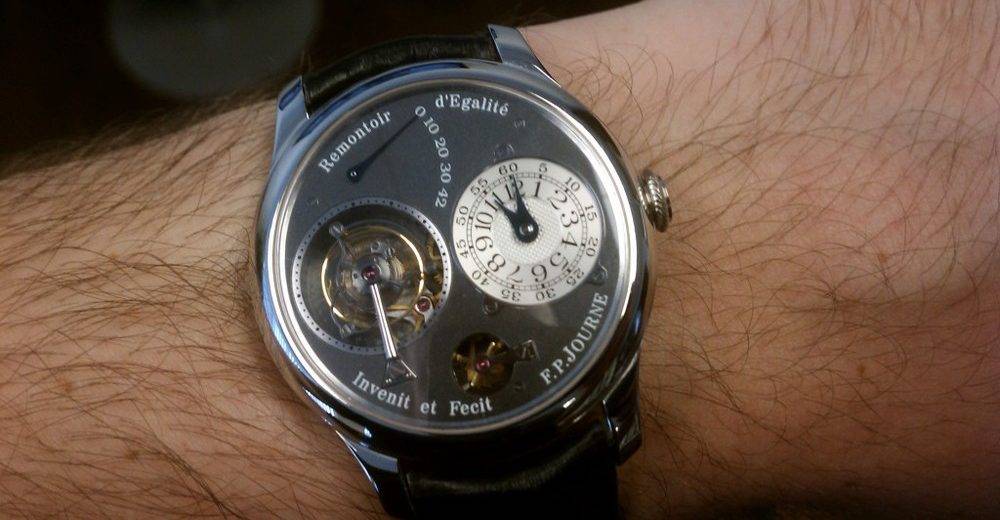
None the less, the tourbillon is a beautiful complication when executed correctly.  This time was also a golden age for jaw-droppingly gorgeous tourbillons.  In my mind, none are better than the FP Journe Tourbillon Souverain.

Francois-Paul Journe is perhaps the most important independent watchmaker of the period.  He is a man who has a clear vision of what he wants to create, and very explicitly does not care what the rest of the world thinks.  This is a common trait amongst creators who create historically significant pieces – one that is shared by Felix, Max and a few other staples of the industry.  An AHCI watchmaker, Francois Paul has created a true throwback company – a living watchmaker who has created a real, global brand.  Abraham Louis Breguet would be proud.

We are still in the early days and I believe many of these early Journe pieces will be historically significant in times to come.  That being said, I have particular preferences which have been reflected in my collecting.  As far as versions are concerned, I tend to prefer the older pieces, before the gold movements were introduced.  They have a whimsical feeling of an early brand before it takes off, whereas the more contemporary pieces are clearly more polished and slick.  The Resonance is undoubtedly an important watch with one of the most beautiful movements in the world, but for me, the Tourbillon is the real winner.

Technically, it is still one of the most interesting tourbillons produced – a completely manufacturer movement with a huge tourbillon, beautiful cage, and a remontoir d’egalité.  I believe they are one of the biggest bargains on the market.

When I buy a watch and think of its historical significance, I like to imagine myself paging through an auction catalog 20+ years from now.  Second hand values now are of no real importance (Van Gogh paintings were cheap for a long time!).  What matters is when you look through that future catalog and see a watch that truly represents the best of an era.  Here you have the most successful independent watchmaker in the golden age of independents, the early piece that launched his company, and the most beautiful tourbillon of the tourbillon era.  To me, this is a no-brainer standout in that catalog.

Plus, name me a “classic” watch that is nicer than this Ruthenium dialed limited edition version.  For my money, this is as good as a round watch gets.

Tomorrow, I’ll continue the series and get into the real exotics with URWERK.  Stay tuned…


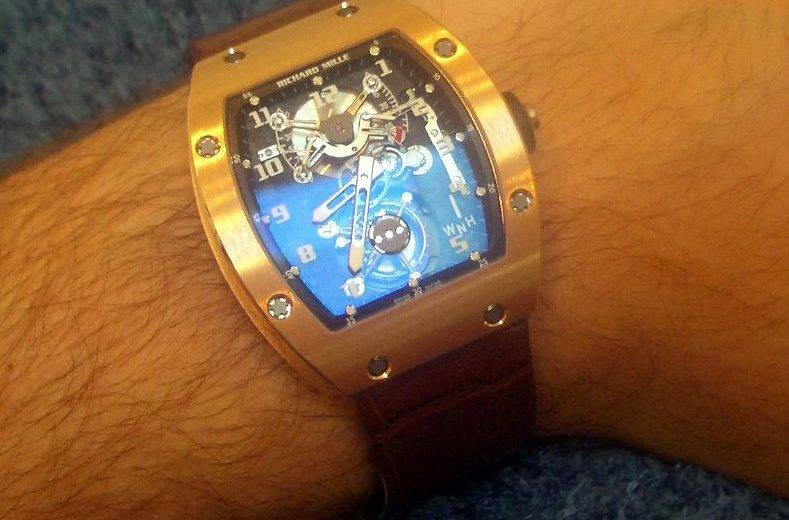
Collecting History: Richard Mille RM002

The Richard Mille RM002 is the watch that got me hooked on “exotic” watches.  In the early 2000′s, like most other people, I had no idea that $100,000+ watches existed.  The idea was simply absurd.  Why would anyone spend that much on a watch?  How could it possibly be worth it?

Sure I had seen some watches that I considered incredibly expensive.  I recall seeing a Patek perpetual calendar chronograph (3970) which at the time, I believe, was about $40,000.  A watch exists that is 4 times that price?  Unimaginable.

I vividly remember seeing the watch for the first time.  A friend had just bought it, and I asked to see it out of sheer amazement at the price.  Of course it looked cool, but still I did not fully understand.

And then I put it on my wrist.

Really, it all changed for me right then.  The watch was SO comfortable – both ergonomically, and psychologically.  It wasn’t ostentatious, or old and stuffy.  It was me.  I could see myself wearing it every day.  And so I decided right then, that some day I would buy one.  A year later I saved up enough to write the check, and I wore that watch nearly every day for the next 18 months.

So that is my very personal story with this watch, but why does it mean the watch is historically important?  Richard Mille was able to influence an entire market of people just like me.

He blew the lid off pricing, somehow making people comfortable paying many times what they had ever paid for a watch.  You may think this is a negative for consumers, but actually it has been perhaps the single biggest driving force towards all of the incredible watches we see now.  If no one was comfortable paying $188,000 for a watch, something like an MB&F HM4 could never exist.  There is simply no way to make some of these amazing sculptures with pre-Richard Mille pricing.

I’ve also heard Richard Mille being described as a “gateway drug”.  It is an exotic watch that Patek and Vacheron guys still often feel comfortable wearing.  In a pre-exotic world, it was a great first step to getting people used to the crazier things to come.

And so, just as this watch started my fascination with Contemporary Horology, in many ways it paved the way for much of what was to come.  No discussion of this period of watchmaking would be complete without Richard Mille.

Tomorrow I will take a look at another pioneer in the history of Contemporary Horology, and a very important stop in my collecting history, FP Journe.

Collecting History: An Overview

To this point in the blog, I have focused a lot on my views on the industry, and working with MB&F.  I figured that would be a unique take, as I really did not want to write a typical watch blog with pictures and info on watches.  But I do have another unique take – I am a watch collector who has owned and worn many of the rarest pieces in the world, met their creators, and had the time and information to reflect on this journey through collecting.

I believe that we are in the midst of a golden age of watchmaking.  Certainly I would put the beginning in the early 2000′s.  Whether we are in the middle or towards the end remains to be seen.

So, over the next several days, I am going to write posts about watches that I have owned.  They may or may not contain very many pictures or information on the watch itself.  What I am going to try to do is highlight why I feel the watch is particularly special and how I believe it will be historically significant looking back on this era of horology.

Also, I am not a wealthy person and yet these are watches that I purchased with my own limited resources.  I will try to explain the decision making process that went into each.

So stay tuned tomorrow.  I think I’ll kick it off with Richard Mille…

New iPad Tomorrow – useful?

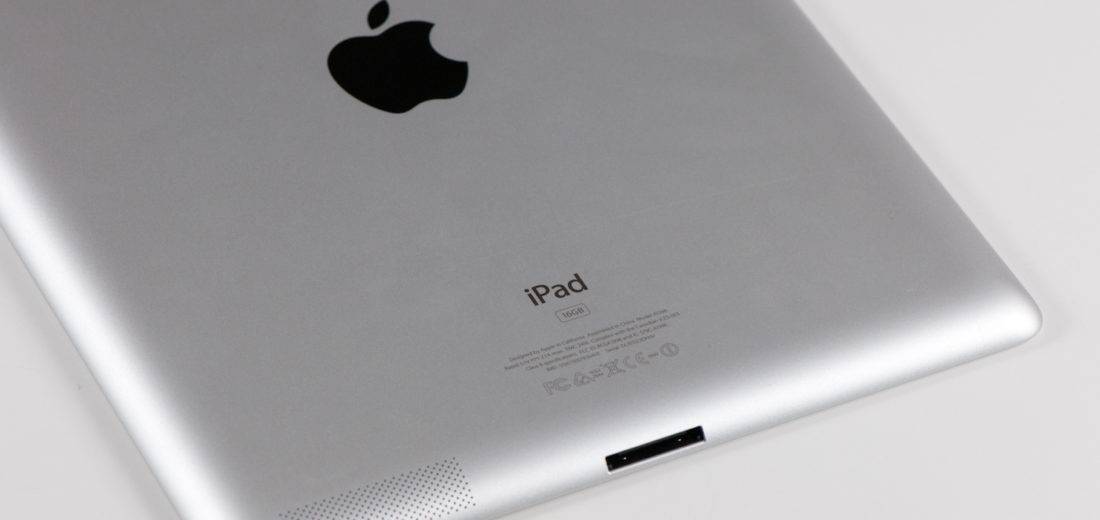
What else could I talk about on Tech Tuesday but the new iPad 2 that is going to be unveiled tomorrow?

I don’t expect very many surprises: faster processor, better screen, front camera, maybe even a Thunderbolt port, and hopefully a few updates to iOS.  So the questions are, do these updates really matter, and is there much use for a tablet in general?

Full disclosure: I am a huge Android fan.  Here is a true story from this morning that is a microcosm of why I don’t use iOS.  My mother recently got an iPad.  She is an Android phone user.  She is in New York and realized she does not have any of her contacts on the iPad.  So, she called tech support (a.k.a. me).  I had to explain to her that there was no way to get her contacts onto her iPad without hooking it up to her laptop and connecting through iTunes.  REALLY?!  In 2011??  Frankly, the fact that you have to hook a brand new iPad up to a computer to get it to work is borderline offensive.

Until Apple embraces the cloud, I don’t feel like any updates will be particularly useful.  I can concede that iOS is more polished and easier to use than Android, but that is because it lacks a ton of useful features, including true multi-tasking and a good notifications system, which are EVERYTHING in mobile.

But this gets to a larger point.  What are tablets for?  I bought an iPad the first day it was available.  Played with it for two weeks.  Was impressed with a few apps.  And then never used it again.  I gave it to my wife who uses it in bed.  I have a feeling this is not uncommon.  How many people really use their tablet?  How much does usage drop off once the novelty has worn off?  I suspect quite a bit.

What do you all think?  Are you excited for iPad 2?  What features are you looking forward to?  Do you really use your tablets?